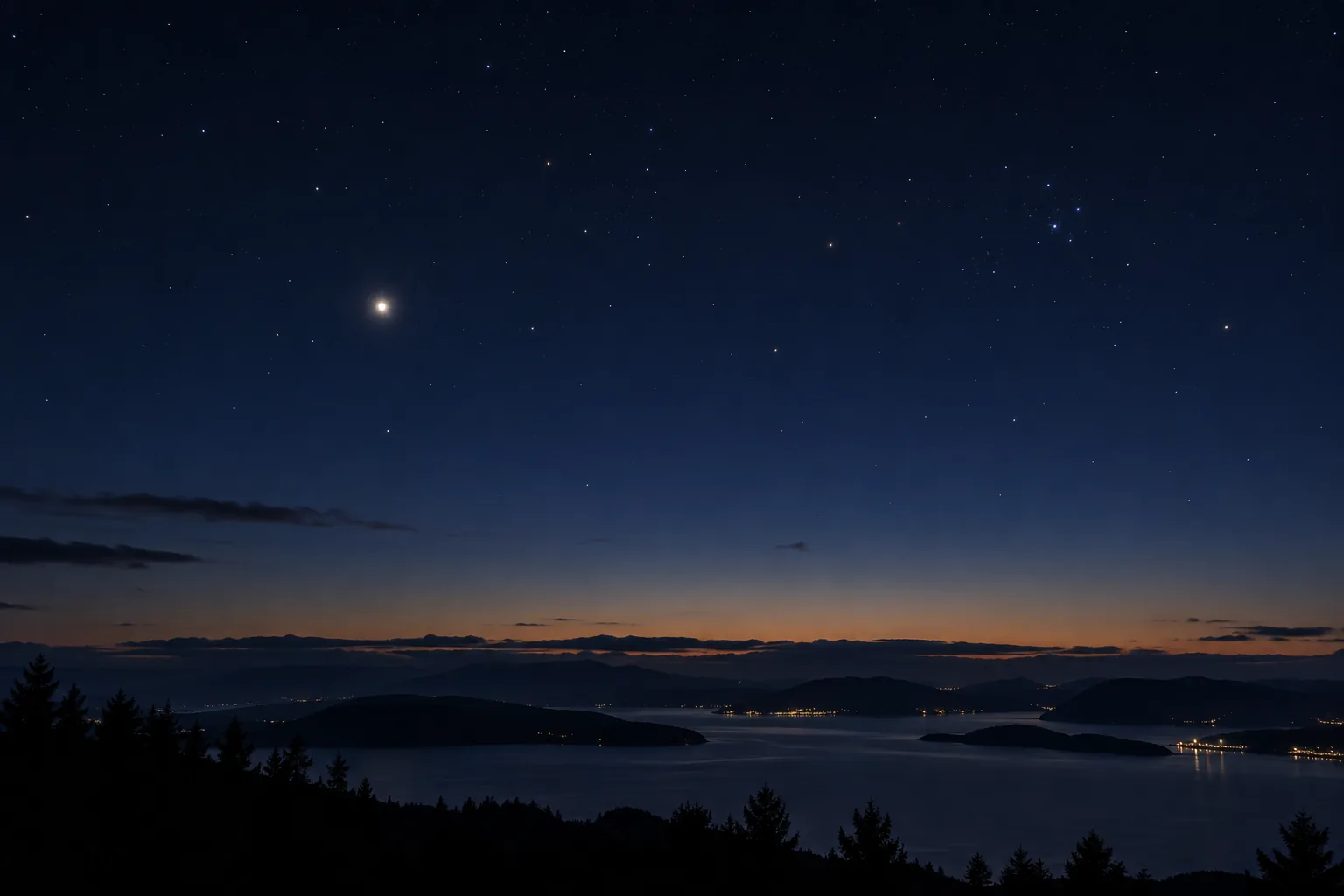
The atmosphere bends starlight
Stars often seem to shimmer, while Venus or Jupiter can look comparatively steady. Is that because stars and planets emit light differently? The difference is mostly how their light appears after passing through Earth’s atmosphere.
A point-like star shows the motion clearly
A star is so far away that it looks like a point of light. As its light travels through layers of air with changing temperature and density, the path bends slightly. Because the star appears point-like, the motion is easier to notice as a changing position or brightness. Astronomers call this twinkling or scintillation.
A planet’s disk averages the effect
Planets are much closer to Earth and appear as tiny disks rather than perfect points. Light arrives from different parts of that disk and travels through slightly different patches of air. If one path shifts, light from another part can partly average out the effect. That is why planets usually appear steadier than stars. NASA describes atmospheric turbulence as the cause of stellar twinkling and notes that planets’ apparent disks make it less obvious.
Planets can shimmer too
A planet is not guaranteed to look perfectly still. Near the horizon, its light travels through more atmosphere and can shimmer. On a turbulent night, even a planet may seem to flicker or wobble. A star high overhead can sometimes look steadier because its light crosses less air.
Twinkling is not the only clue
Twinkling alone is not a reliable way to identify a planet. Planets often shift position against the background constellations over days or weeks, while the pattern of stars changes very little over a short period. Compare the sky at different times or use a sky chart, keeping in mind that visibility changes with season and hour.
Light pollution, thin clouds, and dust can also make viewing harder. A phone camera may show a different effect because autofocus and exposure adjustments change the image. A steady-looking star does not mean its light is completely unaffected by the atmosphere.
Twinkling from the atmosphere is different from a star’s intrinsic change in brightness. Stable air can make a star appear steadier, while true stellar variability requires separate observation.
The takeaway: Stars look point-like, so atmospheric motion shows up as twinkling. A planet’s small disk averages out some of that motion, although planets can shimmer near the horizon.