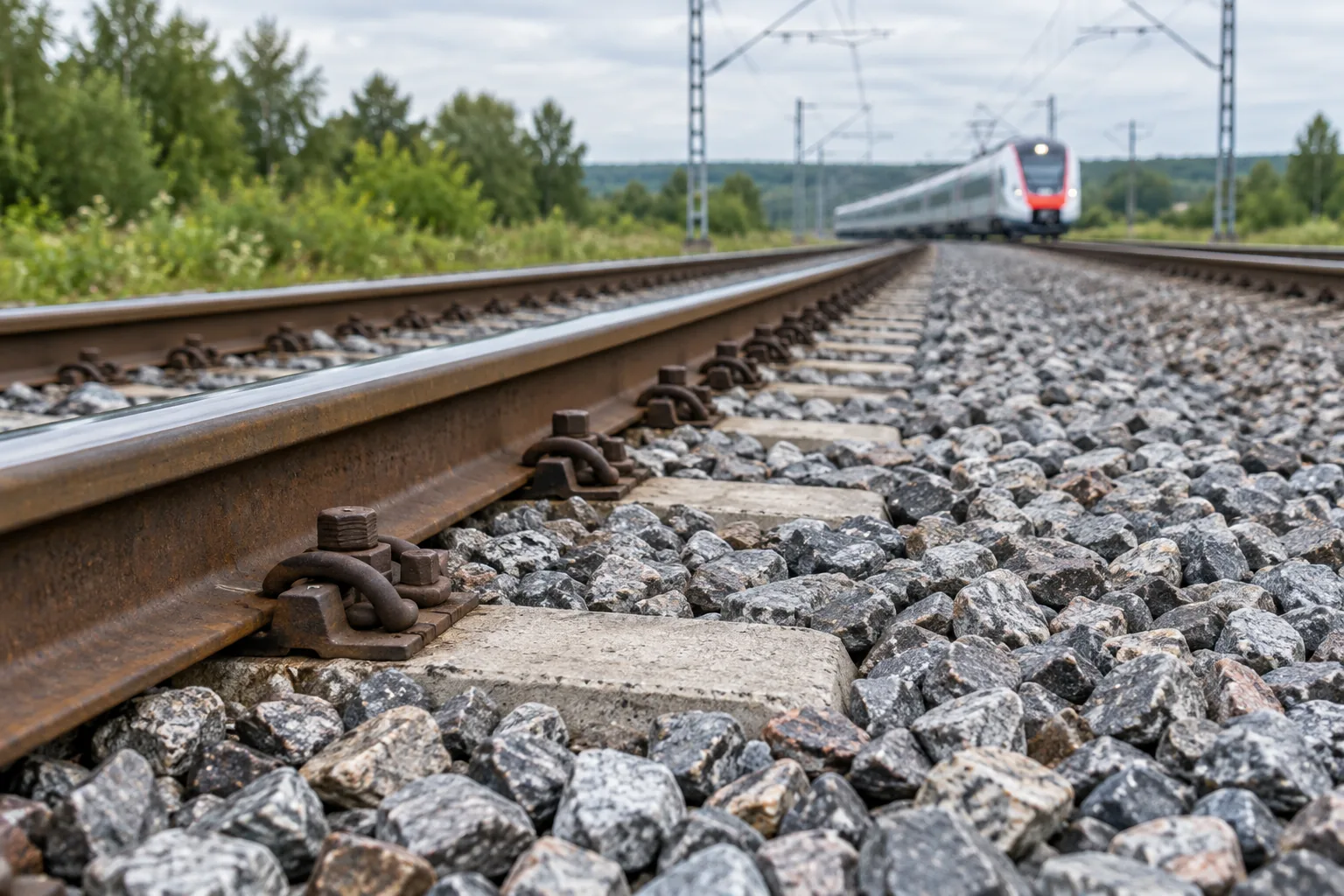
Train loads pass through several track layers
Railway tracks sit on a deep bed of crushed stone called ballast. Why not lay rails directly on soil? The ballast helps spread the forces from trains, support the sleepers, and keep the track stable.
Gaps between stones let water drain
A train’s weight passes from its wheels to the rails, then to the sleepers beneath them. Sleepers hold the rails at the correct spacing and transfer the load downward. Ballast spreads that load over a wider area instead of letting it concentrate at a few points. The Federal Railroad Administration describes load distribution and track restraint among ballast’s functions.
Angular stones help resist movement
The gaps between stones also help water drain. Rain can pass through the ballast rather than pooling around the sleepers. Standing water can weaken the ground or wash soil away, so drainage helps protect the track foundation.
Ballast can be maintained and adjusted
Crushed stones have rough, angular edges that interlock better than smooth round stones. That helps resist sideways movement and settling as trains pass repeatedly. Over time, however, stone can break down and dirt can fill the gaps, reducing support and drainage. Railways inspect and maintain ballast to keep it working.
Not every railway uses loose stones
Ballast also makes some track adjustments possible. Crews can add or tamp stone to raise or realign sleepers. Not every railway uses ballast: some tunnels, urban railways, and high-speed sections use concrete slab track, which has a different design and maintenance approach.
Ballast is one part of a larger system. Rails, sleepers, fasteners, the track bed, and regular maintenance work together to hold the track in position and carry train loads safely.
Ballast does not drain indefinitely: dirt can fill gaps and reduce drainage. Crews also inspect the sleepers and track bed, since the stones are only one part of the structure.
The stones support the sleepers rather than touching the rails directly. Sleepers maintain rail spacing, ballast helps hold them, and the track bed transfers forces to the ground; the system shares the work.
The takeaway: Track ballast spreads train loads, supports sleepers, drains water, and helps keep rails aligned. Some railways use slab track instead of loose stone.