Remotes send infrared pulses
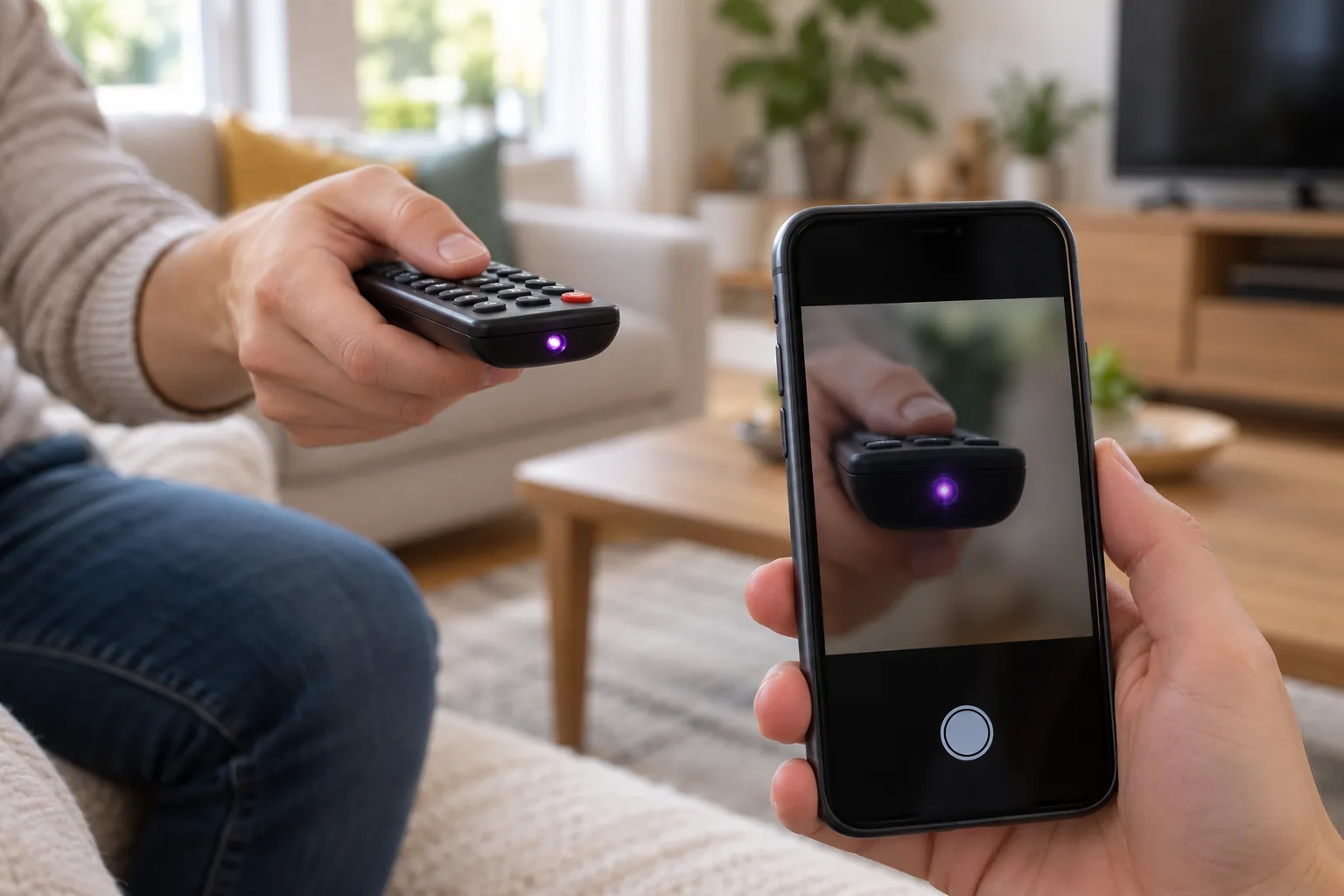
When a TV remote stops working, people sometimes point its front at a phone camera and press a button. A tiny purple or white light may appear on the screen. The remote is not necessarily shining visible purple light, and the camera is not using night vision. It may be detecting infrared.
Why a camera may detect the light
Many remotes use an infrared LED to send short pulses when you press a button. Infrared has a longer wavelength than the visible light humans can see. The remote flashes it in a coded pattern rather than leaving it on continuously. The TV reads that pattern as a command such as power, volume, or channel.
A quick test you can try
A phone camera sensor can respond to some infrared light. Cameras often include an infrared-reducing filter to keep colors accurate, but the filter may not block every bit of infrared. Light that reaches the sensor can appear as a bright dot. Its color may look white, purple, or pink depending on the sensor and the camera’s image processing.
No light does not always mean a broken remote
To try the test, open the phone’s camera, point the remote’s LED toward it, and press a button while watching the screen. A blinking dot suggests that the remote’s battery, button, and transmitter are producing some signal. Try a few buttons one at a time.
A blinking dot is only one clue
No visible dot does not prove that the remote is broken. Some phones filter infrared more strongly, and front and rear cameras may behave differently. The result also depends on the camera app and shooting mode. Some remotes use Bluetooth or radio signals instead of infrared, so a camera test will not detect those transmissions.
Seeing a dot also does not prove that every part of the remote works. A worn button contact, an incompatible signal, or an obstructed TV receiver can still prevent the device from responding. The camera test is a quick clue about infrared emission, not a complete diagnostic tool.
Hold the remote’s front near the camera without pressing it against the lens, and watch briefly as you press a button. The color on the screen is the camera’s rendering, not the actual visible color of infrared.
The takeaway: A phone camera may detect infrared from a remote even though your eyes cannot. A visible blink is a useful clue; no blink does not automatically mean the remote is faulty.