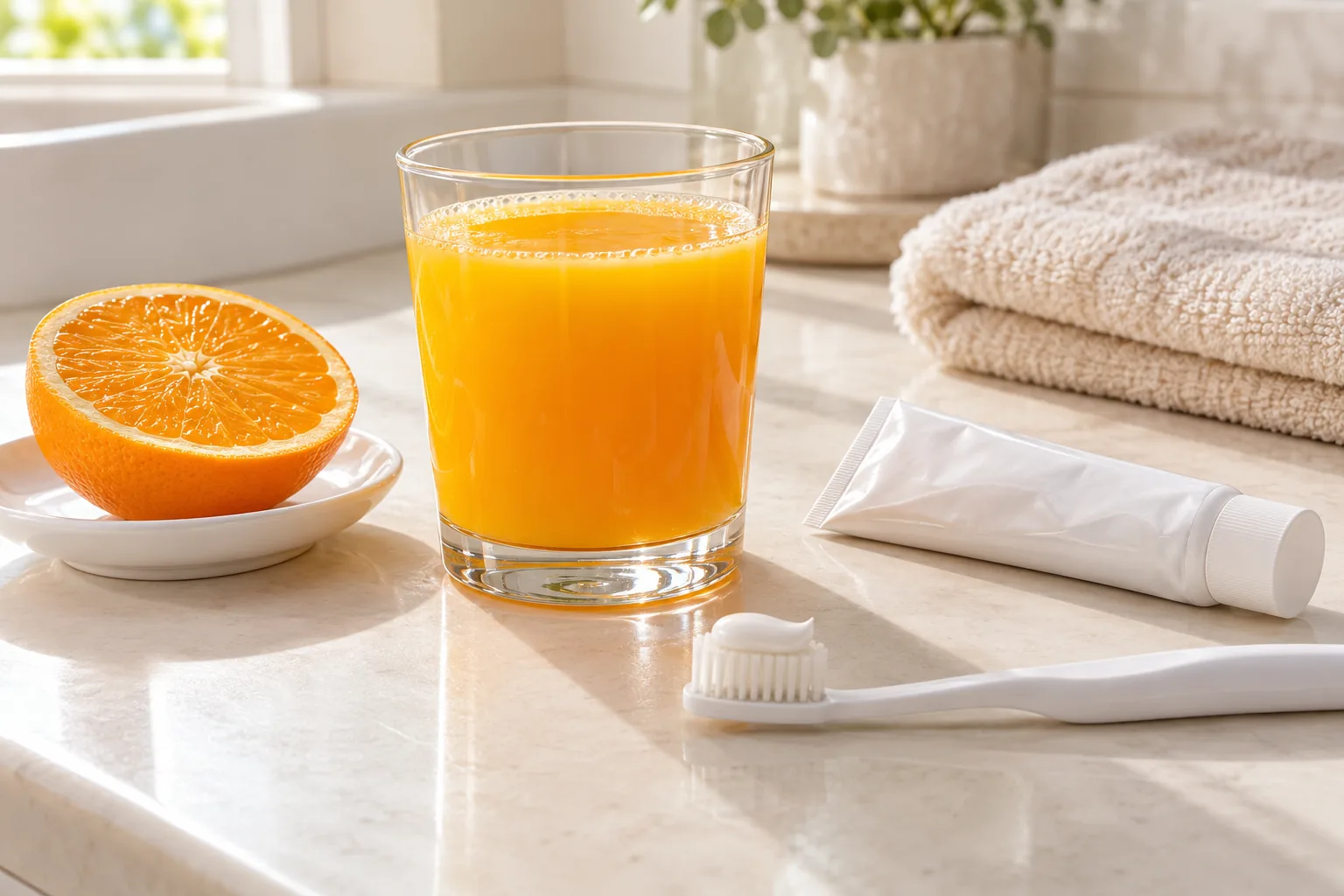
You brush your teeth, take a sip of orange juice and pull a face. It tasted perfectly normal yesterday. Before you check the date on the carton, someone else drinks from the same carton and notices nothing unusual. Why the difference?
Mint is an obvious suspect. The cool flavor left by toothpaste seems an awkward match for oranges. Flavoring can play a part in the experience, but mint is not the only ingredient to consider.
Look at what makes the toothpaste foam
Many toothpastes contain sodium lauryl sulfate, usually shortened to SLS. It is a surfactant used for functions that include foaming and cleaning.
The American Chemical Society’s ingredient description identifies SLS in products such as toothpaste and shampoo and explains its foaming and oil-removal action. It is there to do a job, not as an incidental extra.
SLS can also affect how tastes are perceived. If the balance of sweetness and bitterness changes, an otherwise familiar drink can seem very different. The shift is in the experience in your mouth, rather than the juice suddenly becoming a different beverage.
Less sweetness can change the whole impression
Orange juice is not simply sweet. Its familiar flavor includes several sensations together. Change the prominence of one part and the overall combination can feel unfamiliar.
A taste experiment described in ACS’s ChemMatters found reduced sweetness from sucrose after SLS exposure and increased bitterness from citric acid. In that experiment, citric acid’s sourness changed very little.
It would therefore be misleading to say that toothpaste simply makes all bitter substances taste more bitter. The same account reports reduced bitterness from a different substance. Taste is more complicated than a single sweetness switch and a single bitterness switch.
There is no need to take one experimental number and apply it to every juice or every person. Everyday products and exposure conditions differ. The useful point is that brushing can alter the relative sensations that make up a drink’s taste.
Not every toothpaste or person is the same
Toothpaste formulas vary. Some omit SLS, and others use different surfactants. Their flavors and the sensations they leave behind also differ. The fact that a product is toothpaste does not guarantee an identical experience.
An ACS Chemical & Engineering News article on toothpaste tablets describes a formulation using a different surfactant and discusses SLS’s connection to unpleasant orange-juice taste after brushing. The ingredient list reveals differences hidden by the single word toothpaste.
People can experience the change differently too. The writer of the ChemMatters article notes that orange juice actually tastes fine to her after brushing. Something that is striking to you need not feel equally striking to someone else.
This is not a test of whether your toothpaste is good
An unpleasant sip does not, by itself, show that a toothpaste is a bad product or that you brushed incorrectly. The question here concerns a change in perception between brushing and eating, not a test of cleaning performance.
ACS’s Reactions explanation uses this familiar morning experience to explore toothpaste chemistry. There is more going on in that ordinary sip than it first appears.
The answer: the same juice can taste different after brushing
When ingredients such as SLS affect taste perception, sweetness can seem weaker and a bitter impression can stand out more. Mint alone is not the whole explanation, and the effect is not identical for everyone. Next time your juice tastes strange after brushing, consider what has just been in your mouth as well as what is in the glass.
Sources
- American Chemical Society — Sodium lauryl sulfate
- Paola DeCristofaro, ChemMatters / AACT — The Taste Effect of Sodium Lauryl Sulfate
- Chemical & Engineering News / American Chemical Society — What’s inside toothpaste tablets, and can they clean your teeth effectively?
- American Chemical Society Reactions — Why Does Toothpaste Make Orange Juice Taste Bad?