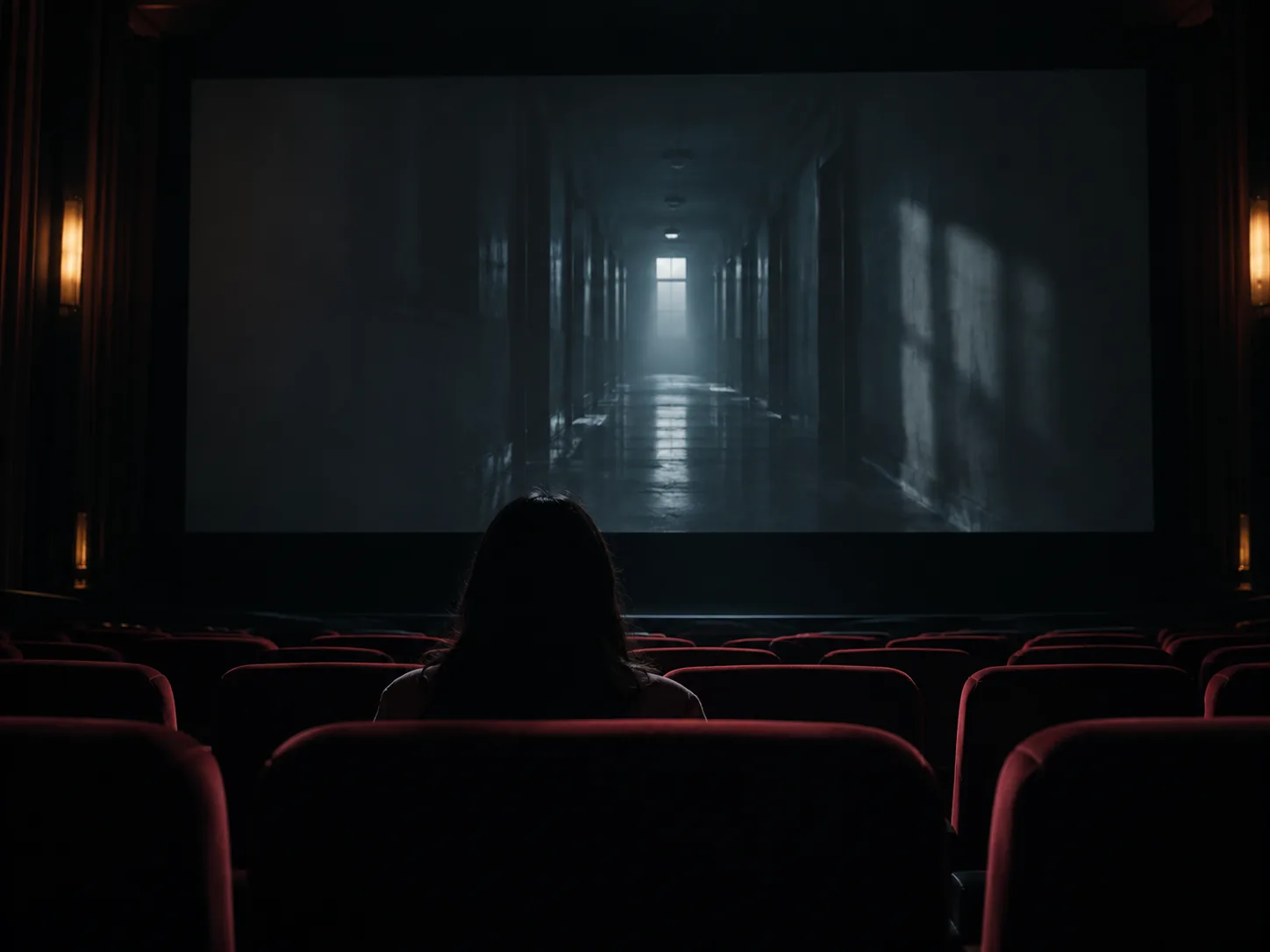
A hallway is empty. A character stops moving. Nothing has appeared on screen, yet you find yourself holding your breath. In a horror movie, a small creak or a sudden break in the soundtrack can feel scarier than the creature itself. Why can a quiet moment make us brace for something we have not even seen?
What you cannot see leaves room for fear
The frame shows only part of the world, but sound can seem to come from beyond it. If you hear a footstep while a character stares into a dark room, you start searching for its source. It could be the house settling—or someone approaching. Until the movie gives you an answer, several explanations remain possible, and that uncertainty can build tension.
Film sound is more than dialogue and music. A low hum, a door shifting, or the faint sound of a room can shape how a place feels. When you cannot tell where a sound came from or how close it is, you may pay more attention to the space outside the frame. Your imagination starts filling in what the camera has not shown.
Silence changes what you expect next
In a movie, “silence” does not always mean absolute silence. The music may stop while faint background noise remains, or a whole layer of sound may suddenly disappear. If a steady sound pattern breaks, you listen more closely for what comes next. Then a small noise can feel unusually prominent.
A University of Edinburgh thesis examined how horror-film sound can activate a viewer’s state of fear. Its discussion suggests that a sudden, sharp sound after a quiet interval can trigger an immediate fear response in some viewing conditions. That is a finding from a particular study, not a formula that works on every viewer or in every scene. Read the University of Edinburgh research record.
Music can warn you before the character knows
An uneasy rhythm or dissonant note can tell you that something is wrong before the character notices anything. You begin to expect trouble. That waiting—wondering when it will happen—is part of suspense. Sound can hint at danger ahead of the story’s visible action.
At other times, a film leaves out music and lets ordinary sounds carry the scene. A refrigerator hum or a clock ticking may feel harmless until it changes or suddenly stops. The familiar sound gives the scene a baseline; a break from that baseline becomes easier to notice.
A neurocinematic study of the shower scene in Alfred Hitchcock’s Psycho found that viewers’ brain-activity patterns tracked important moments in the scene. The authors discuss how film’s visual and auditory elements work with the plot. That study focuses on one film sequence, so it should not be treated as a rule for every horror movie. Read the study in Frontiers in Communication.
Timing matters more than simply turning the volume up
A jump scare often pairs a sudden image with a loud sound. It can make you flinch, but a loud noise without context may be only a momentary surprise. Suspense tends to grow from what came before: the clues you noticed, the threat you expect, and the time you spend waiting.
That is why silence alone is not automatically frightening. If the scene has not given you a reason to expect danger, a quiet patch may just feel quiet. The director is shaping your attention—choosing when to add a sound, when to hold it back, and when to break the pattern.
Listen for the pause next time
When you watch a horror movie, notice what happens to the soundtrack before the scare. Does a low hum disappear? Does a footstep seem to move closer? Does the character hear something that you cannot see? Those details invite you to imagine what lies outside the frame.
Horror sound does not have to tell you “be afraid.” It can make you ask where a noise came from and what might happen next. Sometimes the scariest part is the few seconds when the theater goes quiet and you realize you have stopped breathing.