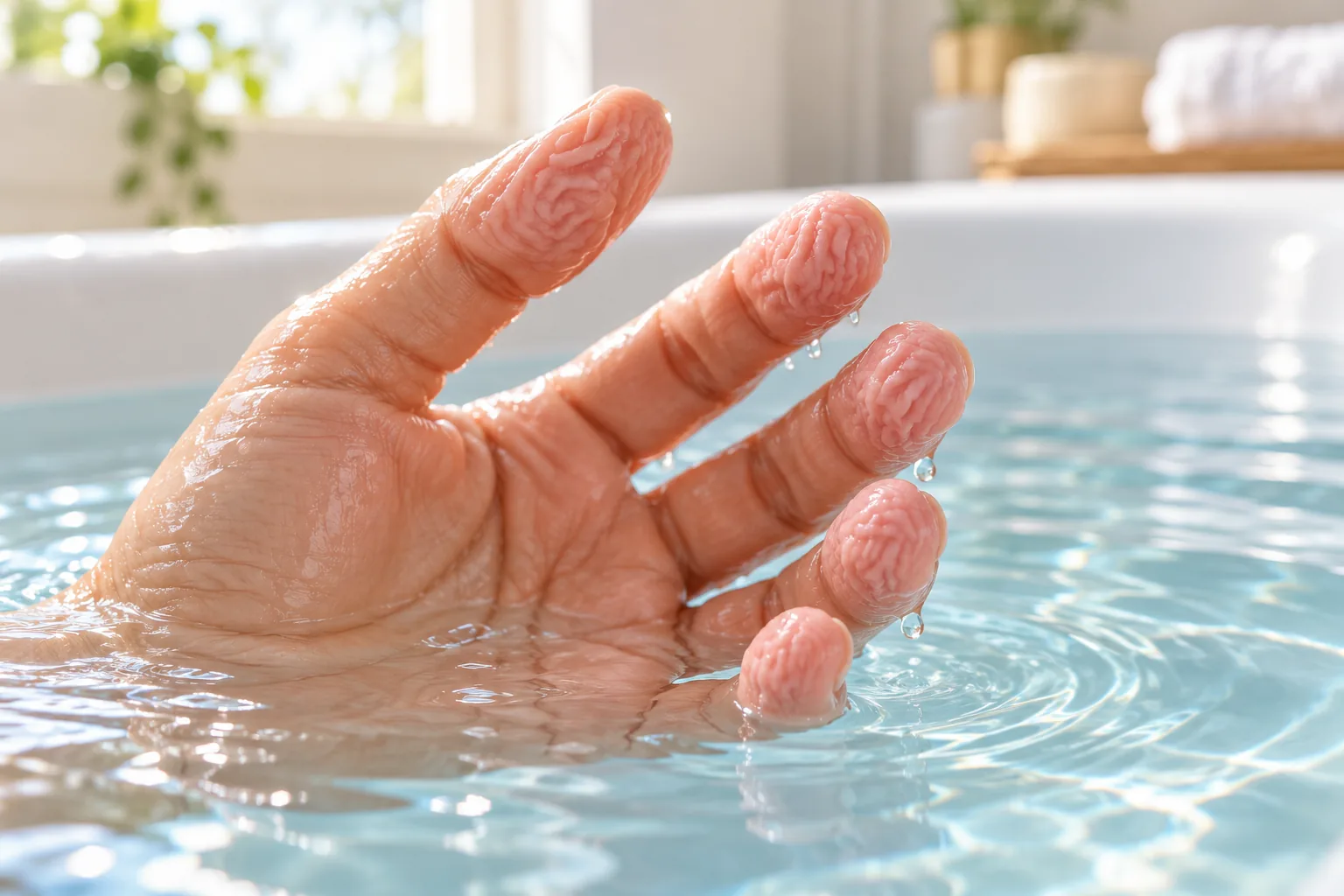
After a long bath or a round of dishwashing, your fingertips may look deeply lined. It is easy to assume that the skin has simply soaked up water and swollen. But water alone does not explain the familiar “pruney fingers.” Research points to a response involving the nerves and blood vessels in the fingertips.
Blood vessels in the fingertips narrow
When fingertip skin stays in water, the sympathetic nervous system becomes involved and small blood vessels in the fingers constrict. In a study that measured blood flow in the hand, researchers found that blood flow fell as the fingers wrinkled. They concluded that immersion-related wrinkling is linked to vasoconstriction. The measurements are described in this study of blood flow during finger wrinkling.
As those vessels narrow, the volume beneath the fingertip skin changes slightly, and the surface forms folds. That is different from the simple idea that the outer skin fills with water and puffs up like a sponge. The timing and pattern also vary; water temperature, how long the fingers are immersed, and individual responses can all matter.
Why do fingers and toes wrinkle?
Wrinkling can also appear on the soles of the feet, areas of hairless skin that help us feel surfaces and make contact with objects. Because the response involves the autonomic nervous system, researchers have asked whether the folds serve a useful purpose when our hands and feet are wet.
Do the wrinkles help you grip wet things?
One hypothesis is that the grooves act a little like tire tread, channeling water away and helping the skin make better contact with a wet object. In a 2013 experiment, participants with wrinkled fingers moved submerged objects faster than participants with unwrinkled fingers. The researchers did not find the same advantage when participants handled dry objects. You can read the results in the original study.
That does not prove that finger wrinkles evolved specifically to improve grip. A 2014 study did not find that wrinkling improved participants’ dexterity with wet objects or their touch sensitivity. A 2021 study, on the other hand, found that participants needed less grip force to hold a wet object with wrinkled fingers. The experiments measured different tasks, so their results do not settle the question for every kind of handling. Compare the 2014 study with the 2021 study.
So what is happening to your fingers?
Water-induced finger wrinkles are linked to an autonomic response and narrowing blood vessels in the fingertips; they are not simply a sign that the skin has absorbed water. The idea that the folds can help us handle wet objects is intriguing, but studies have not reached one universal conclusion. Next time your fingertips wrinkle in the bath, think of it as your body responding to the water—not just your skin getting soggy.