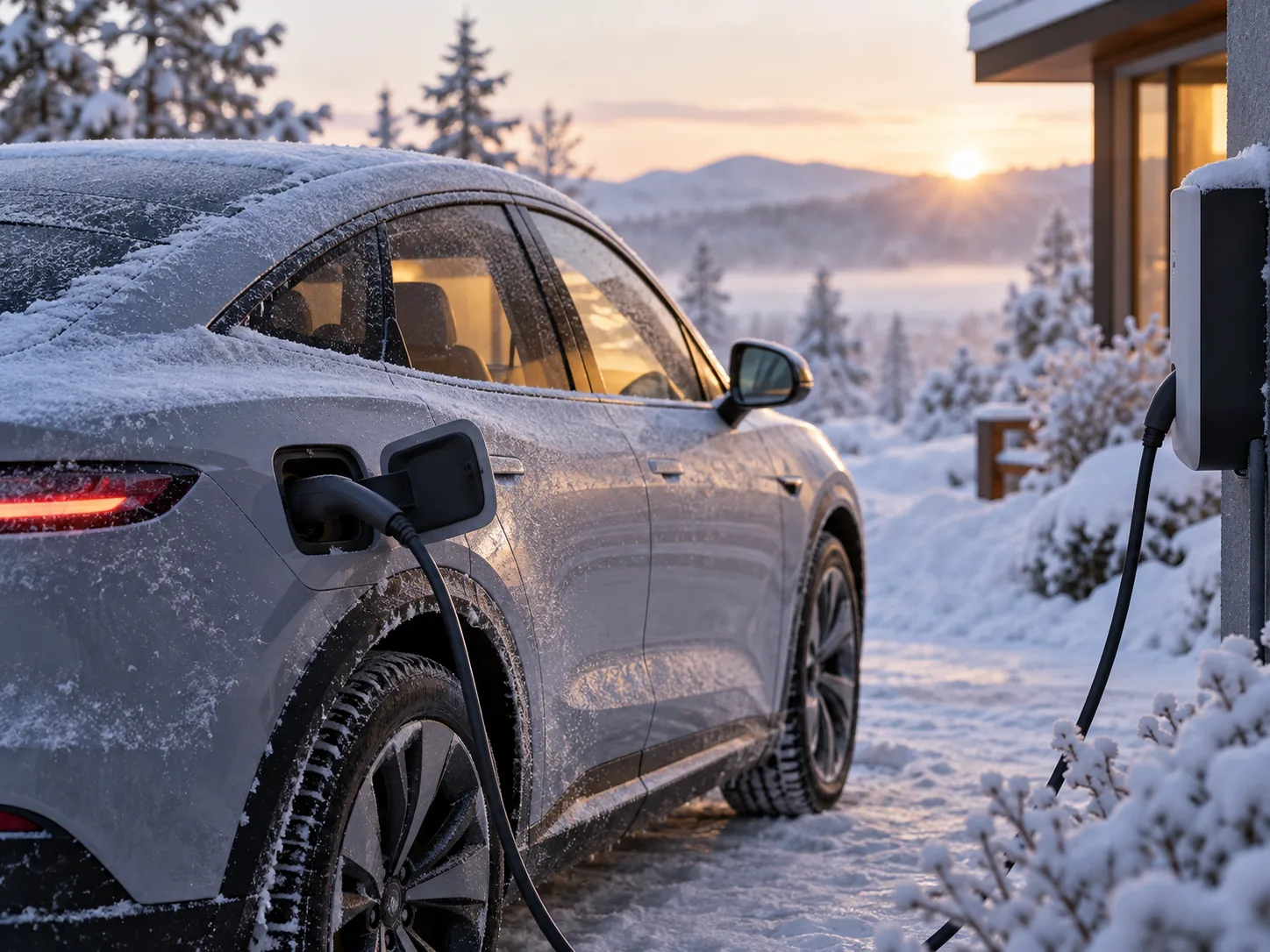
Does your EV seem to lose range as soon as winter arrives? Cold weather can shorten the distance from a charge, but it does not automatically mean the battery is failing. Battery temperature, cabin heat, trip length, and the car’s design all matter.
Cold affects the battery—and the car may warm it
Low temperatures slow the chemical processes and ion movement inside a battery. The car may use some of its stored energy to bring the battery closer to its preferred temperature, so less is available for driving. The effect varies with the battery, thermal-management system, outside temperature, parking, speed, and route.
A U.S. Department of Energy and Argonne National Laboratory report measures cold-weather performance under defined test conditions. Read the report.
Cabin heating draws from the same battery
Unlike a gasoline car, an EV cannot simply use engine heat to warm the cabin. Heating uses battery power, and warming a cold interior quickly can add to the load. Some EVs use heat pumps, which can move heat efficiently in suitable conditions, but their benefit depends on temperature and vehicle design. Check your owner’s manual for the system and any preconditioning feature.
Short trips and the dashboard estimate matter
Repeated short drives may require the cabin and battery to warm up more than once. Snow, rain, traffic, and heated seats can also change energy use. Meanwhile, the range shown on the dashboard is an estimate that may respond to recent driving and climate-control use—not a fixed promise. A sudden change in that estimate alone does not prove battery damage.
What helps before a winter drive?
If your EV supports it, precondition the cabin and battery while plugged in. The U.S. Department of Energy recommends using this feature when available; follow your vehicle’s instructions because systems differ. See its winter EV tips.
Keep the windows clear and use enough heat to drive comfortably. Check tire pressure, plan charging stops on longer trips, and leave extra range in severe weather. Safety and visibility come first.
Winter range is shaped by several conditions working together. Compare similar routes while noting temperature, speed, heating, and parking. That gives you a clearer picture than judging the battery by one changing number.