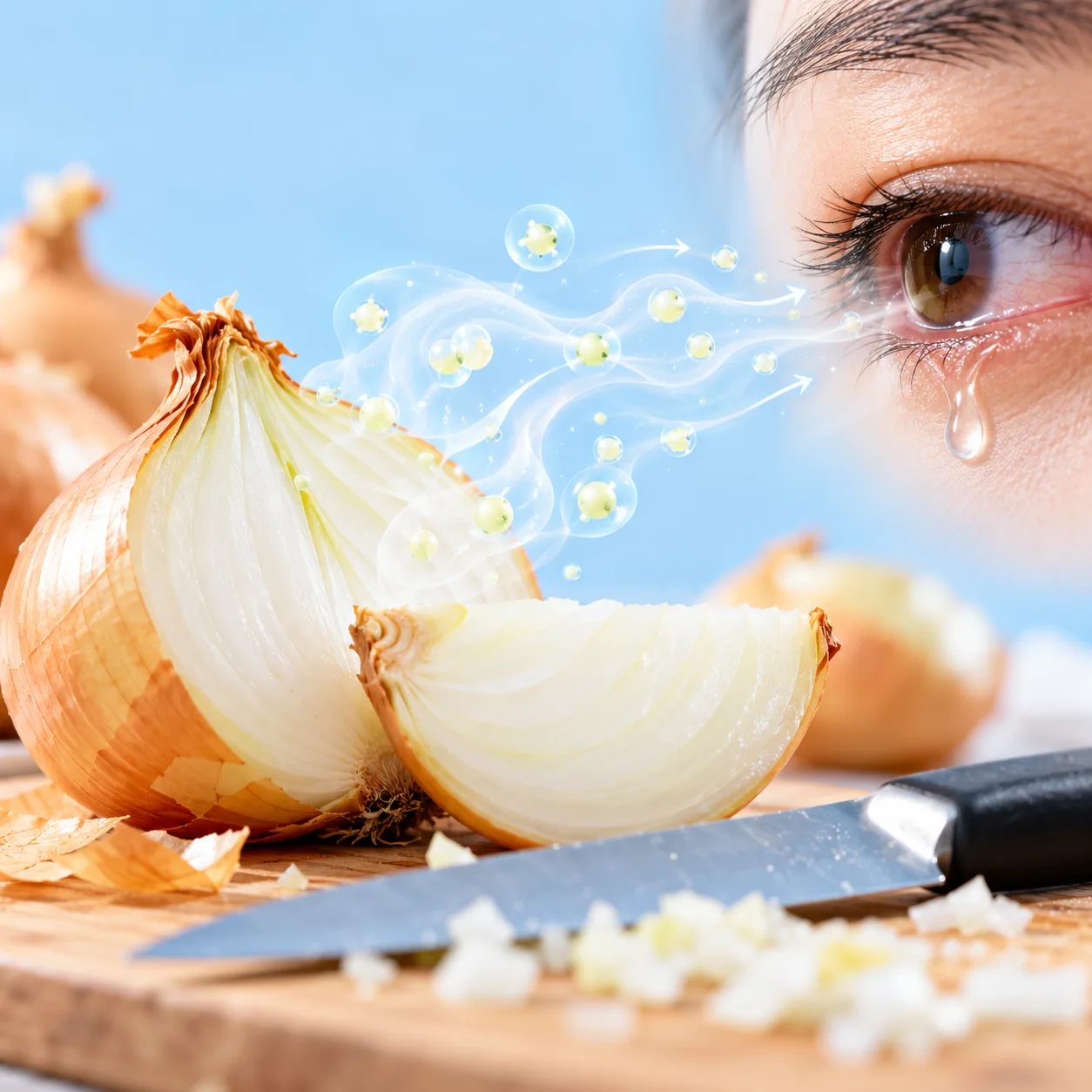
You pull out an onion to make dinner, and before long your eyes are watering. It can feel as if the onion is making you cry on purpose. But the tear-triggering chemical is not simply sitting there inside an intact onion, waiting to escape. The reaction starts when you cut it.
A knife starts a small chemical reaction
An onion’s cells keep certain sulfur-containing compounds and enzymes apart. When a knife breaks those cells, the contents mix and a chain of reactions begins. One enzyme, lachrymatory-factor synthase, helps produce a volatile irritant called syn-propanethial-S-oxide. The American Chemical Society explains how this compound forms when an onion is cut. Read the ACS explanation of the onion tear factor.
Researchers have also studied the enzyme involved in making the tear-producing compound. That research examines the enzyme’s structure and role. The short version: cutting is the trigger that brings the ingredients together.
Why do your eyes react?
The volatile irritant can travel through the air and reach the surface of your eyes. The nerves there detect the irritation, and your tear glands make more tears to wash it away. That is why onion tears are different from tears caused by sadness: your eyes are responding to an irritant.
Cutting keeps breaking fresh cells, often close to your face, so more of the compound can form and disperse nearby. How much reaches your eyes can vary with the onion, your cutting setup, and the airflow around you. If one onion makes you tear up more than another, it does not mean you are unusually sensitive.
Can you make the tears less intense?
The practical goal is to reduce how much irritant reaches your eyes. Work where air can move, avoid leaning directly over the onion, and use eye protection if you are especially sensitive. A sharp knife and a controlled cut may also help limit splashing.
A 2025 study measured tiny droplets produced while cutting onions and found that cutting conditions affected how many droplets were ejected. Those lab results do not prove that one knife or cutting style will prevent tears in every kitchen, but they help explain why technique can matter. Read the onion-cutting droplet study.
Does chilling the onion always help?
People often chill an onion before cutting it. Lower temperatures can affect chemical reactions and how readily compounds evaporate, so chilling may help in some situations. But it is not a guaranteed fix. The droplet study also observed that temperature changed the way liquid droplets behaved under its test conditions; that does not translate into one universal kitchen rule.
Try chilling if you like, but pair it with good airflow and a comfortable cutting position. The reason one trick may help one day and not another is that the onion, temperature, knife, and room conditions all play a part.
Some onions are less tear-inducing
Onions vary in flavor and in the sulfur compounds that contribute to pungency. Scientists have also investigated onions in which the tear-factor enzyme is reduced. In one study, suppressing lachrymatory-factor synthase changed the onion’s sulfur-compound profile, too—so reducing tears can affect more than just the eyes. See the study on silencing onion lachrymatory-factor synthase.
Next time an onion makes you tear up, remember: the onion was not holding tears inside. Your knife broke its cells, a chemical reaction produced an airborne irritant, and your eyes started rinsing it away.