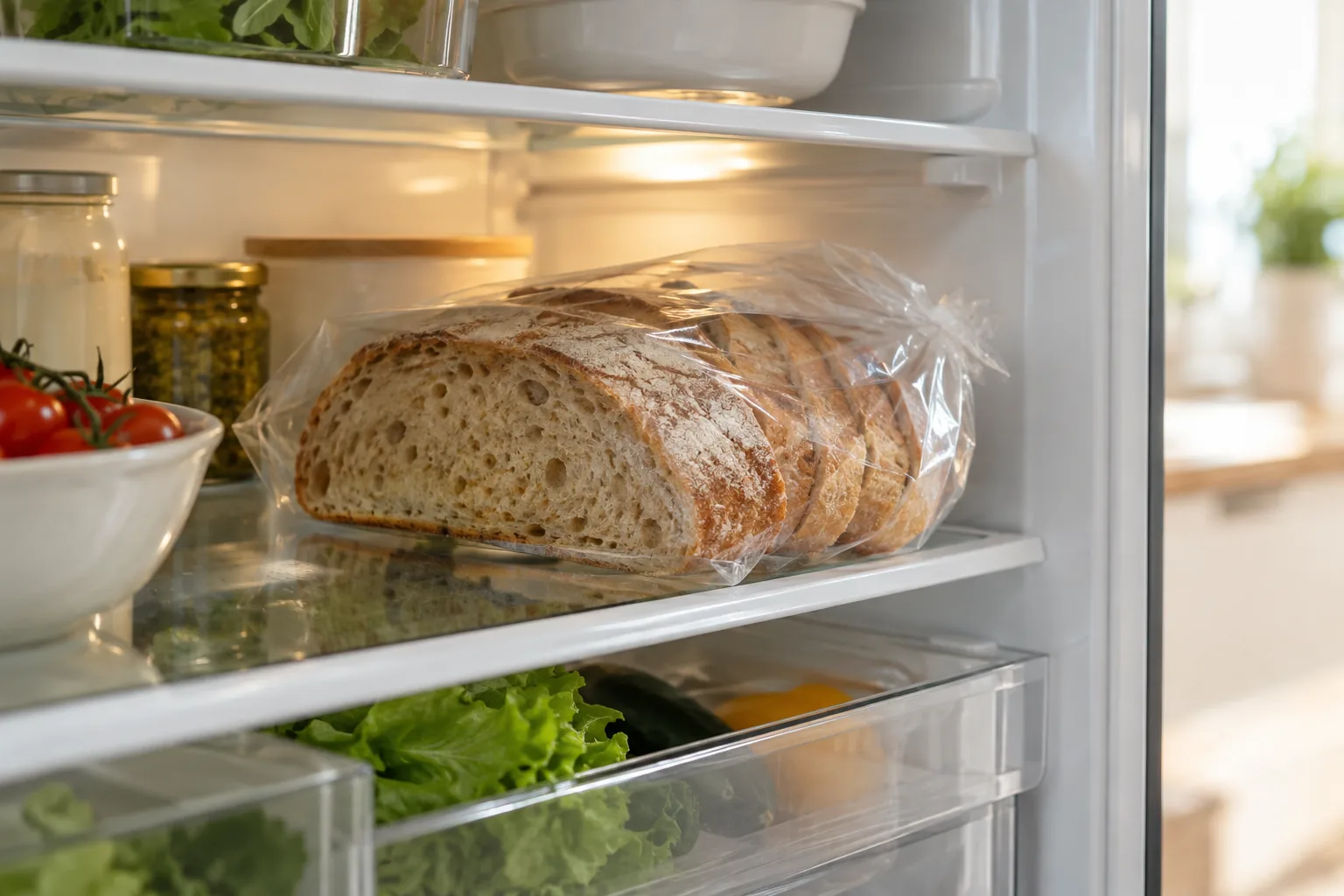
Half a loaf is left on the counter. The fridge seems like the sensible place to keep it fresh, yet tomorrow's slices feel noticeably firmer. Has the refrigerator somehow made things worse?
It helps to split freshness into two questions: is the bread free from spoilage, and does it still have a soft texture? Refrigeration can help with one while working against the other.
Staling is more than drying out
An open bag lets moisture escape, which certainly affects texture. But even tightly wrapped bread can become firm. Changes within its starch are part of the explanation.
During baking, starch changes as it encounters water and heat. After the loaf cools, starch molecules gradually reorganize. This process, known as retrogradation, goes along with changes in how moisture is distributed. The crumb becomes less elastic and firmer.
A 2021 study of bread storage examined starch changes and moisture movement alongside spoilage. Describing stale bread simply as bread that has lost all its water misses part of what is happening.
Colder does not always mean slower
A fridge slows many changes in food, so it is tempting to assume that every process follows the same rule. Starch reorganization in bread can proceed faster at refrigerator temperatures.
The study found that lower storage temperatures accelerated firming under its tested conditions. Bread type, ingredients and packaging still affect the rate. This is not a promise that every loaf will turn hard on the same schedule, but it explains the familiar disappointment of refrigerated sandwich bread.
There is another useful twist: refrigeration and freezing are not interchangeable. Calling both options cold storage hides an important difference.
For longer storage, consider the freezer
In its bread-storage guide, King Arthur Baking recommends suitable room-temperature storage or freezing, rather than refrigeration, when preserving the texture of ordinary bread. Think separately about bread you will eat soon and bread you want to keep longer.
Freezing does not preserve a just-baked loaf perfectly forever. It can nevertheless be a useful choice when bread is wrapped properly. Dividing it into portions also avoids taking out an entire loaf whenever you want a slice.
King Arthur Baking’s freezing and thawing advice describes cooling bread before wrapping and choosing whole-loaf or portioned storage to suit how you plan to eat it. A slice for toast and a large loaf for sharing need not be prepared the same way.
This is not advice to leave cream-filled bread out
The texture discussion mainly concerns ordinary bread without perishable fillings. Cream-filled products and other items with refrigeration instructions need their own safe storage conditions. Avoiding staling is not a reason to ignore the package.
A hot, humid room also changes the practical decision. Start with the product's instructions and when you will eat it. Keeping bread pleasant to chew and deciding whether it is safe to eat remain separate questions.
If mold is visible, reheating is not the solution. The USDA food-safety guide recommends discarding bread and baked goods because their porous structure can allow contamination beneath the surface.
The answer: longer-lasting is not always softer
Ordinary bread can firm faster in the fridge because refrigerator temperatures encourage starch retrogradation. Store bread for immediate use according to its instructions and your conditions; for longer storage, consider wrapping and freezing it. The useful question is not simply where it is cold, but when you plan to eat the bread.
Sources
- Alpers et al., Foods (2021) — Impact of Storing Condition on Staling and Microbial Spoilage Behavior of Bread
- King Arthur Baking — The best way to store yeast bread
- King Arthur Baking — How can I freeze my bread? (And defrost it, too!)
- USDA Food Safety and Inspection Service — Molds on Food: Are They Dangerous?