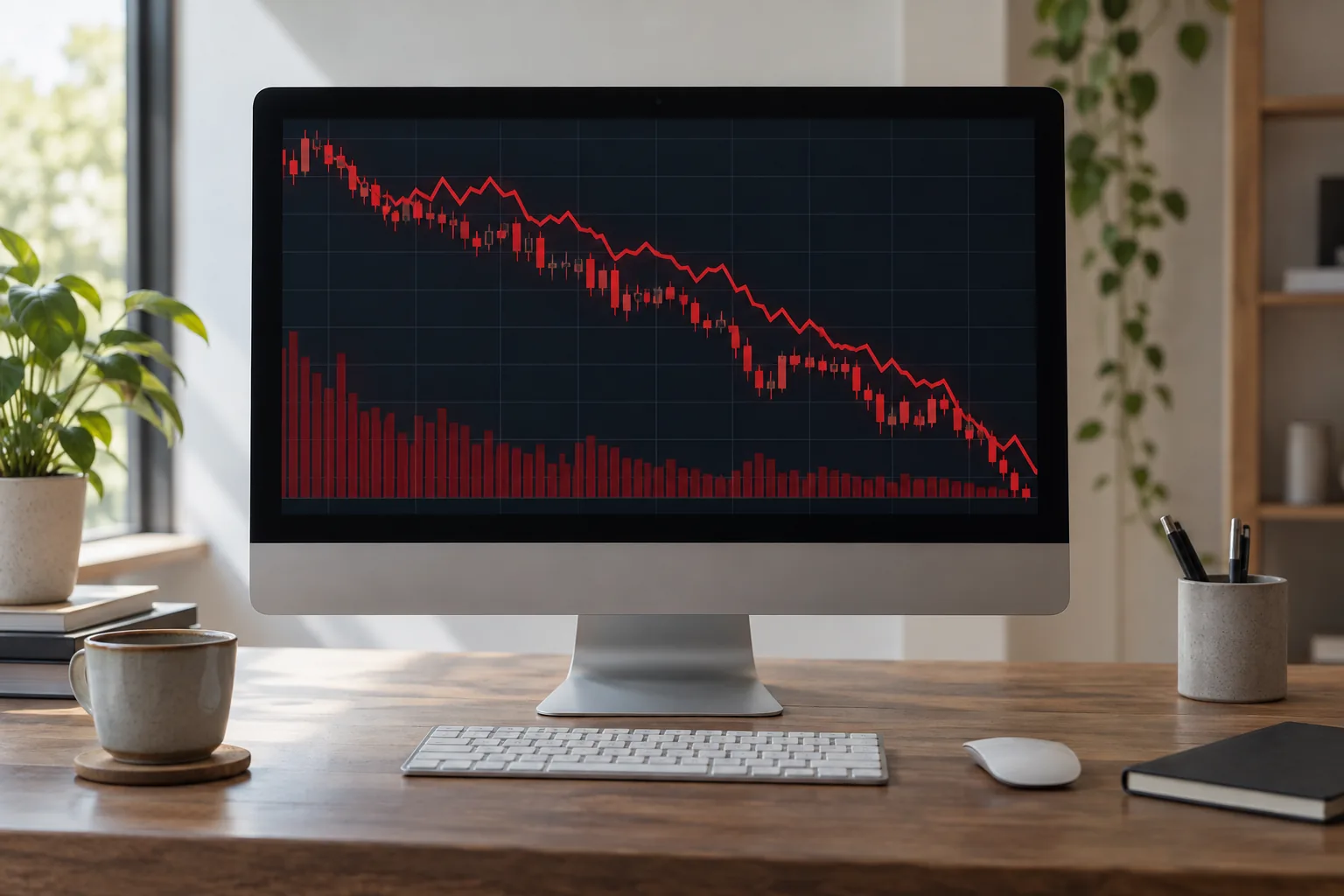
“Billions wiped off the stock market.” It sounds as if a huge pile of cash has disappeared. Did somebody else pocket it? Or did money literally vanish? The mystery becomes easier once you ask what the number in a shareholding actually represents.
Your portfolio value is not a cash vault
Imagine owning 100 shares at $10 each. Their market value is $1,000. If the price falls to $5, those same 100 shares are worth $500 at the new price. These are hypothetical numbers, not an example of a real company.
No separate $500 cash balance had to leave your account. You held 100 shares, rather than $1,000 in cash, and the price used to value them changed. A falling house price does not mean someone removed banknotes from a safe inside the house.
The SEC's definition of market capitalization makes this distinction clear: share price multiplied by outstanding shares gives a company's public market value. It is not a total obtained by having every shareholder sell simultaneously and counting the cash received.
A smaller trade can change a much larger valuation
Suppose our fictional company has only 100 shares outstanding. Its market capitalization changes from $1,000 to $500 when the price changes from $10 to $5. All 100 shares do not have to change hands for that repricing to happen. Prices established by some trades can affect the valuation of shares that remain held.
“$500 of market value disappeared” therefore does not mean “$500 of cash was traded.” The money described as wiped out in a crash headline usually means lost market value. Reading that number as transaction proceeds leads you down the wrong path.
Where did the money paid for the shares go?
That is a separate question. When you buy already-issued shares from another investor, the payment goes to the seller through the transaction, allowing for costs. The SEC calls the market for previously issued securities the secondary market. This is different from a company raising money by issuing new shares.
Your purchase payment moved when the trade occurred. The later decline describes a new valuation of the asset you still own. A company's falling share price does not, by itself, subtract an identical amount from its bank account.
Separate the cash traded from the value lost
Here is a separate hypothetical example. A company has 1,000 shares outstanding and its share price falls from $10 to $8. The share count stays unchanged; fees and taxes are excluded.
| Measurement | Calculation |
|---|---|
| Previous market capitalization | 1,000 × $10 = $10,000 |
| New market capitalization | 1,000 × $8 = $8,000 |
| Decrease in market value | $2,000 |
| Cash traded when 10 shares sell at $8 | $80 |
The $2,000 valuation decline and the $80 exchanged in that trade are different figures. The buyer pays the seller $80; the entire $2,000 decline does not go into that seller's bank account.
If you bought those 10 shares at $10 and still hold them, the unrealized loss is $20. Selling at $8 produces $80 in proceeds and realizes the $20 loss. The proceeds are neither all profit nor an additional loss on top of the valuation change. A large sale can also move prices, so market capitalization is not a guaranteed cash-out amount.
It is still a meaningful loss
An unrealized loss is not a meaningless one. You could receive less if you sell now, and a lower asset value can affect financial plans or collateral. As the SEC's stock risk guidance explains, prices can fall, and selling below your purchase price produces a loss.
Nor must every dollar of falling market value equal a dollar someone else earned. Many shareholders can all see their holdings repriced downward. Some traders might profit from a fall, but that does not make the entire decline in market capitalization their income.
The answer: the money “lost” in a stock market crash usually means a fall in the market value of shares, not cash secretly transferred somewhere. First separate cash, trading proceeds and asset valuation; the headline becomes much easier to understand.