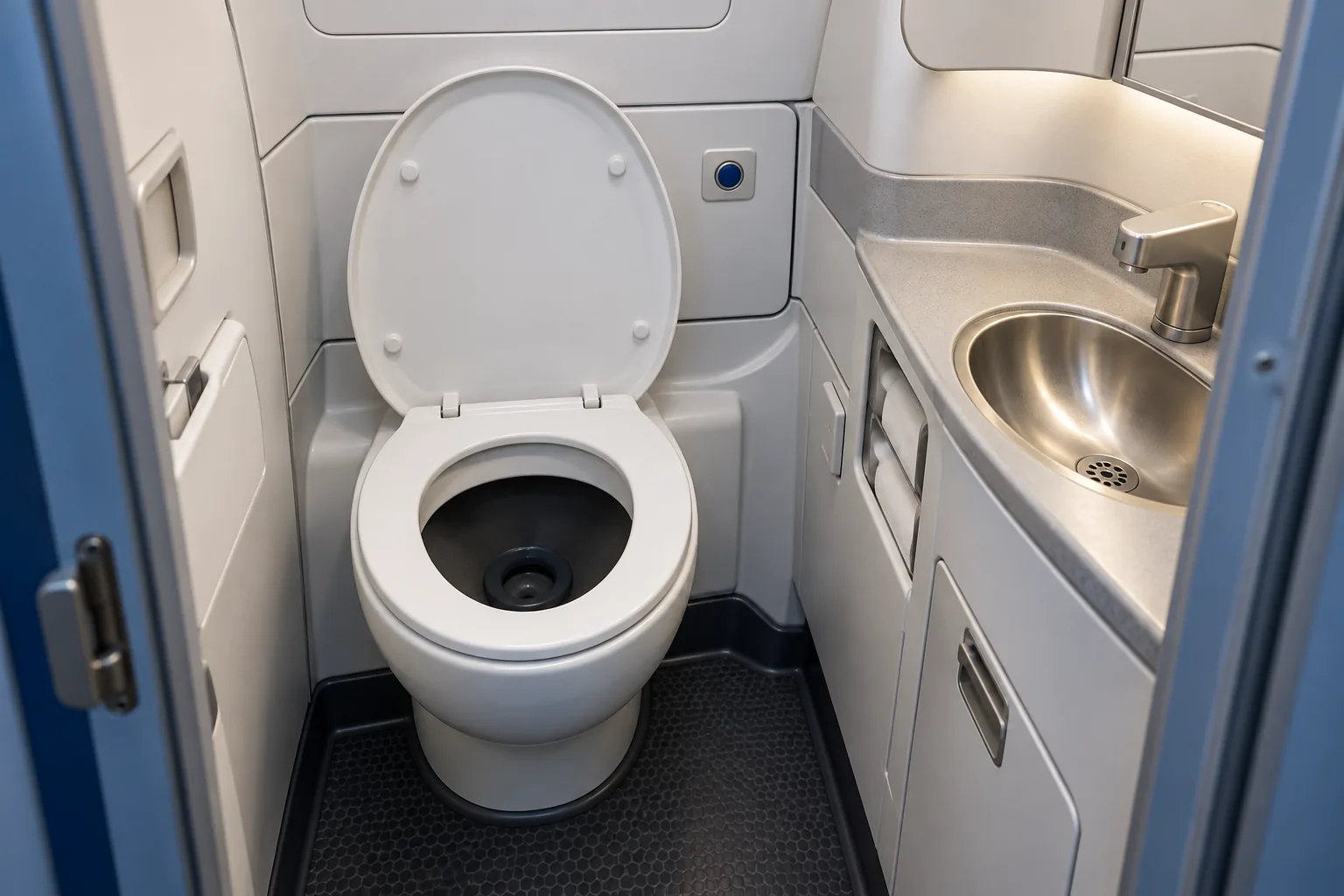
An airplane toilet flushes with a dramatic whoosh. Everything disappears so quickly that it can feel as if the bowl opens straight to the sky. Is the aircraft dropping it outside? The destination is less spectacular than the sound suggests.
In modern airliners, it goes into an onboard tank
Modern passenger-aircraft toilets generally send waste through plumbing to a holding tank inside the aircraft. It is kept onboard and removed by ground equipment after arrival. Pressing flush is not normally opening a hole and dropping the contents out of the airplane.
Aircraft-lavatory manufacturer JAMCO explains that a vacuum toilet moves waste through a pipe toward a lower-pressure waste tank. Disappearing from the bowl and disappearing from the aircraft are different events.
Why does it need so little water?
The strong noise relates to rapidly moving air and suction rather than a large volume of water. A vacuum system uses a pressure difference; the name does not mean the pipe connects to outer space.
JAMCO describes systems that use the pressure difference between the cabin and outside during flight, with equipment lowering tank-side pressure when conditions require it on the ground or at lower altitude. Designs vary, but the toilet does not have to wait until the aircraft reaches cruising altitude to work.
This approach moves waste with relatively little flushing water. Water carried onboard has weight, so that matters. The fast disappearance without a bowl filling with water reflects a different system from the familiar toilet at home.
Who empties the tank?
Among the vehicles servicing an aircraft is a lavatory-service truck or cart. An FAA airport-waste document describes transferring tank contents through a hose into the service vehicle, then taking the waste to airport treatment facilities.
The passenger sees a flush lasting seconds. Storage, ground collection and treatment happen afterward. Looking into the bowl does not reveal the holding tank: the lavatory and the tank are separate spaces connected by plumbing.
What about stories of falling “blue ice”?
Not every such story is invented. An FAA maintenance report documents a case involving liquid leaking from a toilet system and freezing outside the aircraft. Leakage and ice formation are not the normal process of flushing waste out during flight.
Sink water creates another source of confusion. FAA drainage guidance discusses lavatory-sink drains and external icing. Water systems aboard an aircraft do not all necessarily share one disposal route. A statement about sink drainage should not automatically be applied to toilet waste.
A loud departure from the bowl, not the plane
Aircraft systems have changed across models and eras. Historical examples should not be generalized to every modern airliner, nor should one model's tank capacity be treated as universal. The useful question is where a normal flush goes next.
The answer: modern airliner toilet waste is generally collected in an onboard tank and removed on the ground after landing. The whoosh is part of moving it toward storage using little water and a pressure difference, not a signal that it is being dumped into the sky.