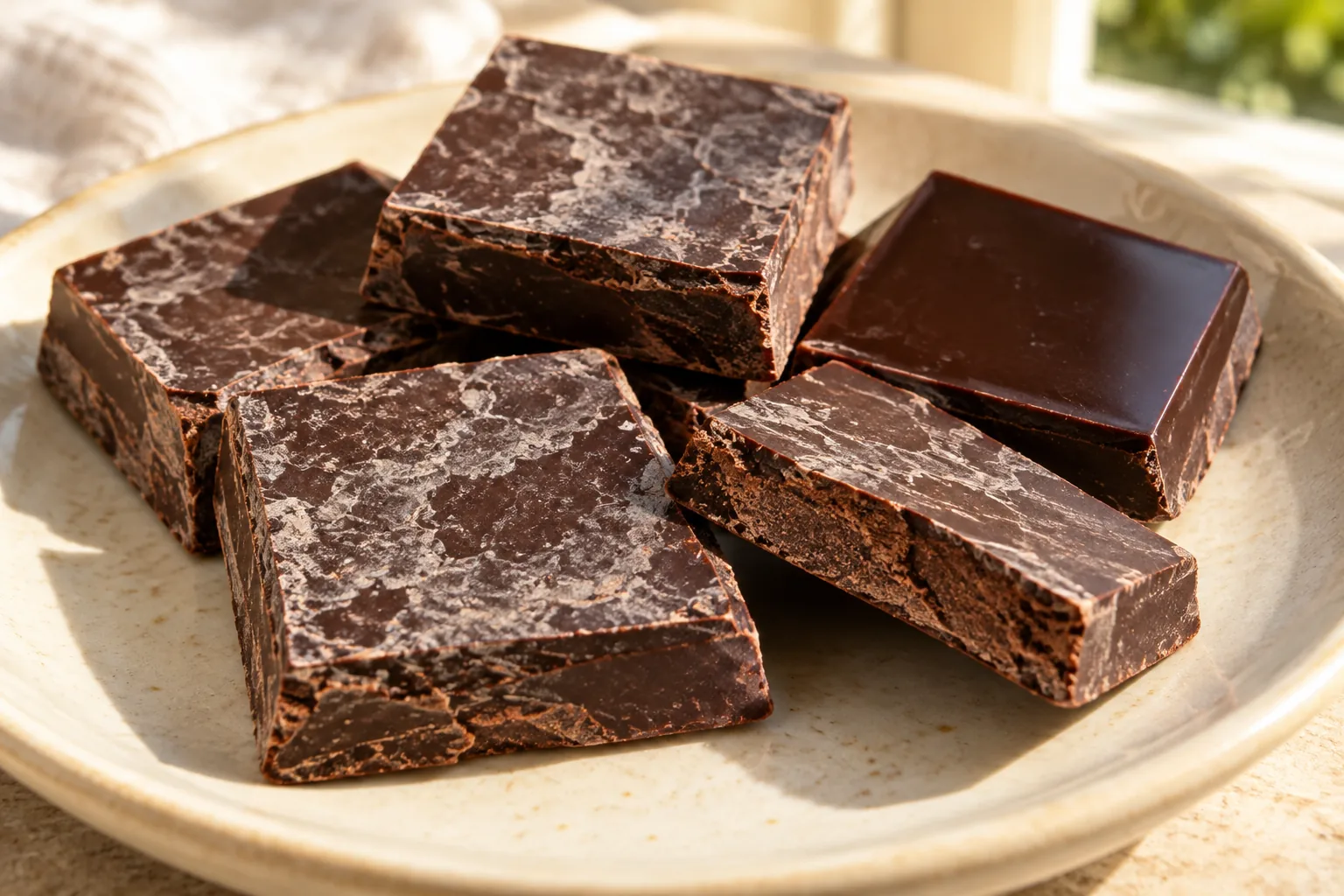
You unwrap a chocolate bar and find pale patches across its dark surface. Was it not perfectly normal a few days ago? It looks suspicious, yet the smell seems familiar. Should it go straight into the trash?
Chocolate can develop a whitish surface change called bloom. White marks do not all have the same cause, but bloom itself is not the same thing as microbial spoilage.
Chocolate’s fat can move
Chocolate contains fats, including cocoa butter. Changes in fat crystals or the movement of fat toward the surface can leave a white or gray film. This is called fat bloom.
According to Callebaut’s technical guidance, high storage temperatures and temperature swings can speed up fat migration. Fat from a filling, such as a nut-based paste, can also migrate into the chocolate shell.
Imagine a bar that briefly becomes soft and later firms up again. Returning to a solid shape does not necessarily restore its original shine and texture. An unmelted-looking bar is not proof that its storage conditions never changed.
Sugar can leave a pale trace too
Moisture on a chocolate surface can dissolve some of its sugar. When that water evaporates, sugar recrystallizes on the surface, leaving a rough, whitish appearance. This is sugar bloom.
Callebaut’s bloom troubleshooting guide identifies humid storage and condensation after temperature changes as possible causes. Opening the wrapper of cold chocolate immediately in a warmer room can expose it to moisture.
Think of droplets forming on the outside of a cold drinking glass. Moisture from the surrounding air collects on the cold surface. On chocolate, that moisture can affect the sugar at the surface.
Color alone cannot certify safety
Bloom is a physical change involving fat or sugar, not evidence by itself that mold has grown. But a photograph or a white patch cannot confirm that bloom is the only change affecting a particular product.
In its confectionery shelf-life guidance, Callebaut distinguishes physical changes such as bloom from microbial spoilage and chemical changes such as rancidity. An appearance problem and a safety problem are different categories.
Filled chocolates need special attention to the filling, not just the shell. Check the product’s storage instructions and date, and consider whether its packaging has been damaged. A familiar change on a plain bar should not be used to judge every chocolate dessert.
An unusual smell, fuzzy growth or uncertain storage history is not something to dismiss as probably bloom. Equally, a pale surface does not automatically mean every affected bar has spoiled. White is a clue, not a complete diagnosis.
Keep temperature and moisture steadier
Avoiding heat, humidity, direct sunlight and frequent temperature changes can help protect the surface. When taking chocolate from a cold place to a warm one, letting it adjust while still wrapped can reduce condensation on the chocolate.
This does not mean avoiding the refrigerator under all circumstances, even in a hot home. Follow the particular product’s instructions. Temperature changes, moisture and the chocolate’s ingredients matter more than a blanket rule about one appliance.
The answer: white does not automatically mean spoiled
White patches can be fat bloom or sugar bloom. They are not, on their own, proof of spoilage or a guarantee of safety. Next time you see pale chocolate, look beyond the color and consider its storage conditions and overall condition.