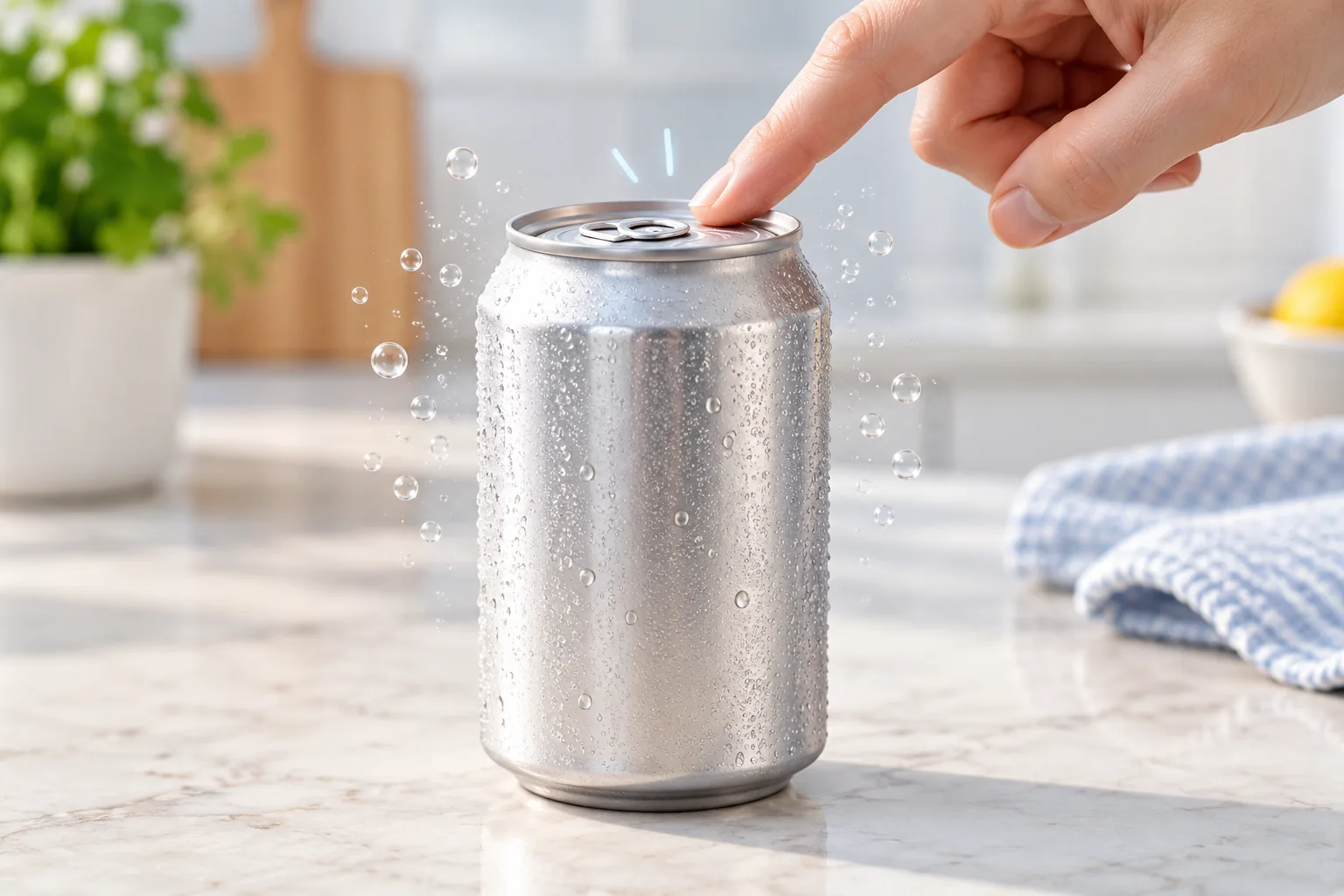
When you accidentally shake a can, someone may tell you to tap the lid before opening it. The idea is that tapping moves the bubbles out of the way, so less foam spills out. It sounds plausible—but does it actually work?
Why does a shaken can foam when you open it?
Carbon dioxide is dissolved in a fizzy drink under pressure. When you open the can, the pressure inside drops. Some of that dissolved gas then escapes as bubbles. As the bubbles grow and rise, they can carry liquid with them and push foam over the rim.
Shaking does not suddenly add more carbonation to a drink. It can spread small bubbles through the liquid and make it easier for gas to escape once the pressure drops. That is why a shaken can may foam up as soon as you crack it open.
The idea behind tapping
The theory is that tapping shakes loose bubbles clinging to the inside wall of the can. Those bubbles would rise into the empty space at the top, leaving fewer places in the drink where foam can start to grow. For this to help, the bubbles would need to detach and rise before you open the can—and the tapping itself could not stir up the drink enough to create more bubbles.
There is another wrinkle: tapping takes time. If you tap a can for a few seconds before opening it, it is hard to tell whether any difference came from the tapping or simply from letting the can sit. People also shake cans differently and tap them with different force, so one successful attempt does not prove the trick works.
What did the experiment find?
A randomized controlled trial tested 1,031 cans of beer, each containing 330 milliliters. The researchers split them into four groups: shaken or unshaken, and tapped or untapped. For the tapping test, a person tapped the side of the can three times with one finger. They then measured how much beer was lost when each can was opened.
Among the shaken cans, tapping did not produce a statistically significant reduction in the amount of beer spilled. The unshaken cans showed no significant difference either. The researchers concluded that tapping a shaken beer can did not prevent beer loss. Read the study.
There is an important limit to that result: the experiment tested beer, and it tested taps on the side of the can—not taps on the lid. Beer and soda can behave differently, so the study cannot prove that tapping the top of a soda can never helps. But it also gives us no reason to promise that lid tapping will stop soda from overflowing. A Live Science explanation likewise describes tapping as an unreliable fix.
Would tapping the lid work better?
Not necessarily. A tap on the lid may move the whole can without evenly dislodging bubbles stuck to its inner walls. Tap hard or repeatedly, and you may end up sloshing the drink and creating more opportunities for bubbles to form. Since the beer experiment did not test lid tapping or soda, we cannot use it to settle that exact question. For now, lid tapping is a plausible-sounding trick, not a proven way to prevent a fizzy mess.
What should you do instead?
If you can wait, set the can upright and give it a little time to settle. If you need to open it right away, crack the tab slowly to let some gas escape, pause if foam starts to rise, and then open it the rest of the way. Those steps are not a guarantee, but they give the bubbles time to calm down instead of releasing the pressure all at once.
So, does tapping the lid stop a shaken can from fizzing over? There is no solid evidence that it does. The large controlled study found no clear benefit from tapping the side of shaken beer cans, and it did not test soda or lid tapping. If you want to reduce the chance of a spill, letting the can sit upright and opening it slowly is the more sensible bet.