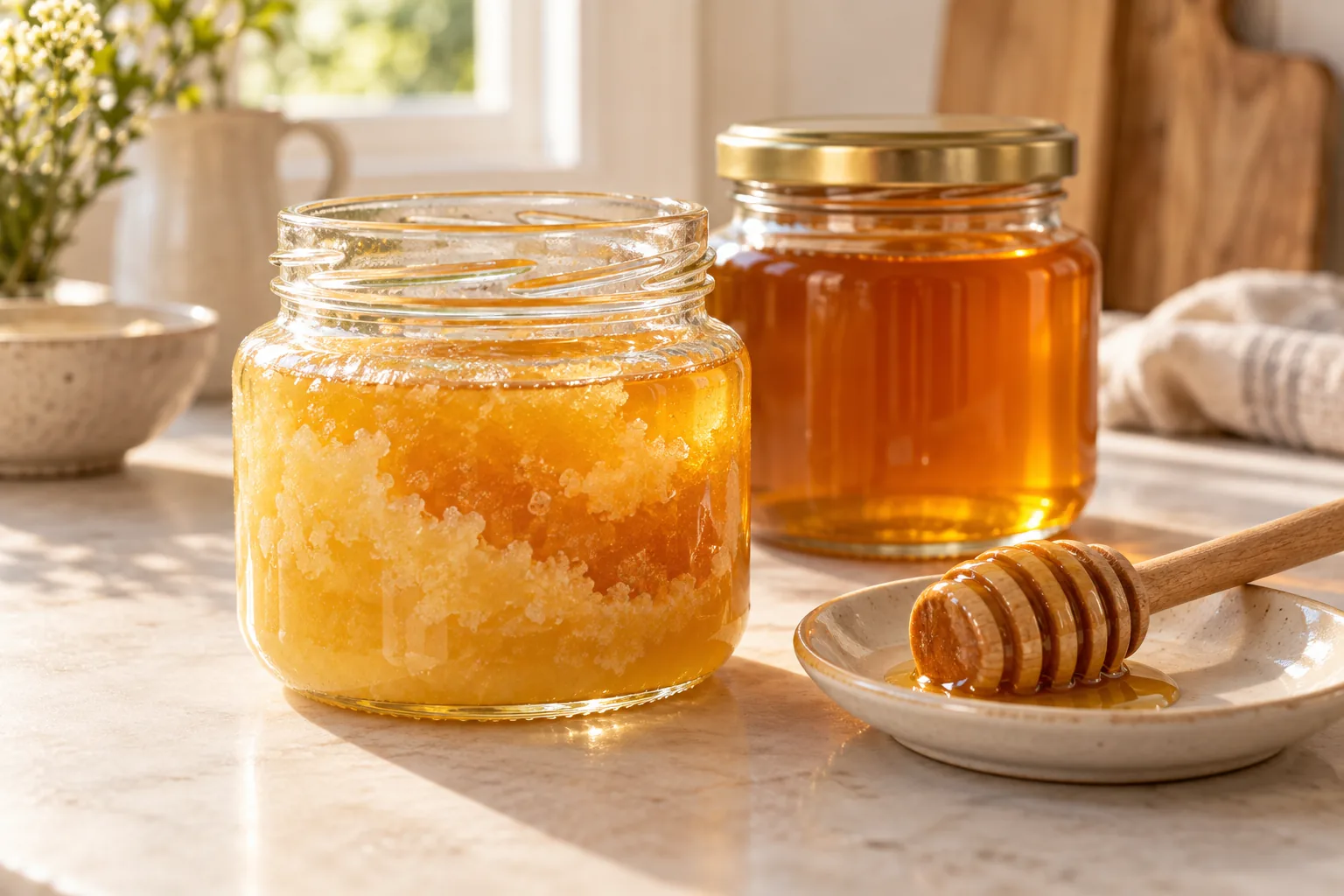
You find a forgotten jar of honey at the back of a cupboard. It is thicker than you remember, with pale grains near the bottom. You nearly throw it away, then remember hearing that honey never goes bad. Why, then, is there a date on the jar?
Two questions are hiding inside that thought: what makes honey keep so well, and what has happened to this particular jar in your home? Separating them avoids treating either discard it or keep it forever as an automatic answer.
Honey is not an easy place for microbes to grow
Honey contains a great deal of sugar. It is not completely water-free, but little water is readily available for microbes to use, and honey is acidic. These conditions make growth difficult for many microorganisms.
The Utah State University Extension storage guide describes commercial honey as suitable for long storage because it resists microbial growth. It also distinguishes this keeping ability from quality changes, including differences in color and flavor.
Long-lasting does not mean that a jar will taste and smell exactly as it did when purchased. Remaining usable and being at its best are different questions. Read the date together with the particular product’s storage instructions.
Does grainy honey mean spoiled honey?
A jar becoming thick or grainy is often crystallization: glucose in honey forms crystals. The change can be striking, but crystallization itself is not the same as spoilage.
The National Honey Board’s guide to honey myths explains that varieties crystallize at different rates. Whether a jar crystallizes is not a reliable home test for authenticity, either. The claim that real honey never crystallizes is not a useful rule.
Liquid honey and crystallized honey can look like completely different products. Appearance and thickness alone cannot tell you everything about safety or purity. The first distinction to remember is that solidifying and spoiling are not synonyms.
Added moisture changes the situation
Honey’s keeping qualities should not be translated into safe regardless of how it is handled. Poor sealing, added water or contamination can change the conditions in a jar. Honey can be affected by moisture around it.
In an extension expert’s response about opened honey, moisture absorbed by a jar that is not airtight is identified as a possible cause of fermentation. The response advises against consuming honey with obvious fermentation.
Use clean, dry utensils and close the lid after use. A wet spoon or one carrying food residue is not something to dismiss on the grounds that honey keeps forever.
That does not mean a single touch from a damp spoon instantly spoils every jar. The point is to avoid introducing moisture and contamination. If the smell or condition is clearly unusual, or you do not know how it was stored, do not use a taste test to establish safety.
Long-lasting does not mean suitable for everyone
Resistance to spoilage is separate from whether a food is appropriate for a particular person. Infants are an important example, regardless of how new the honey is.
The CDC advises against giving honey to children younger than 12 months because of the risk of infant botulism. A fresh jar and a food that keeps well do not remove that warning.
The answer: honey keeps well, but storage still matters
Properly stored honey can last a long time, and crystals alone do not mean it has spoiled. Moisture, contamination and fermentation remain separate concerns. When you find an old, grainy jar, check the product’s instructions and storage history rather than letting the grains alone decide whether to discard it or feel reassured.